Ireland may have been the land that saved western civilization, ((À la Thomas Cahill, How The Irish Saved Civilization: The Untold Story of Ireland’s Heroic Role from the Fall of Rome to the Rise of Medieval Europe
.)) and certainly enjoyed a period of setting priests alongside agricultural products as the major export, but that’s not to say that nothing good came out of the experience. Their perhaps unique relationship with the Catholic church has put Irish comedians in a wonderful position, and combined with a deep love/hate relationship with the English, provides a rich source of material for us all to enjoy. Republicans, Catholics, Patriots, Atheists: here are some of my favourites of Ireland’s sons.
Many of us are probably familiar with the idea advanced in the early days of the Internet, that most users don’t know how to scroll through a website. Today that seems pretty unbelievable. The vast majority of websites, and indeed many of the most regularly visited, not only favour scrolling but to a large extent rely on it for navigation. So have the rules of the so-called ‘fold’ changed since the Internet’s inception? And what role should it play in decisions made regarding a website’s design today?
Viewing the web can be a very personal experience. Depending on your very own choice of browser, monitor or resolution, the web can look a very different place. If you’ve ever for some reason been forced to view one of your regularly visited websites on a much lower resolution monitor, for example, you’ll know what I mean. What once appeared spacious and easy to read suddenly seems squashed and cluttered. The cute little thumbnail images now take up good chunks of room and force you to scroll around them to get at the text. And should that site employ a fixed-width design that is wider than the current resolution, even more space goes to waste with the appearance of a side scrollbar.
How do you turn a free product into a profitable enterprise? That’s normally the challenging issue to be faced in today’s increasingly competitive online market. Internet giant Google continues to have issues attempting to monetise
its expensively
acquired YouTube daughter. Yet game developer Turbine
is looking to do exactly the opposite, converting their current business model into a subscription-supported free product. But does ‘free’ pay?
It certainly appears that Turbine’s decision
to offer their MMO Dungeons & Dragons Online for free has paid off. Hundreds of thousands of new players have signed up to take advantage of the new offer, and despite the ‘free’ price tag, subscriptions are up 40%. In addition, many players are taking advantage of an in-game payment mechanism to buy additional items and open up new sections of the game. Previously the game had required players to pay a one off purchase price, followed by a monthly subscription fee. Now just about anyone can download the game and be playing within half an hour, paying or otherwise. Turbine also maintain that some players are paying even more per month than the previous subscription fee alone, removing an important cap on how much individual players could pay into the game. Rather than seeing players who play without paying as freeloaders, Turbine are confident that such players bring their own benefit to the company, generating interest, advertising via word-of-mouth, and thereby generating new subscriptions and one-off payments.
So was Barack Obama awarded the Nobel Peace Prize last week. Cue gasps of glee, plenty of head-scratching surprise, and a profusion of controversy. Because the question on many people’s minds is quite clear: what for?
Ignoring the fact that Obama was nominated for the award only days after his inauguration, his term thus far has certainly been one of optimism and change. It would be unfair to dismiss his achievements, and plain wrong to chastise his goals. Amongst others, Obama has been responsible for: moving to close the detention facility at Guantánamo Bay; furthering plans for the US withdrawal from Iraq; easing tension with Russia by abrogating plans for the missile defense shield in Eastern Europe; moving to open talks with pariah states North Korea and Iran; extending a palm leaf to the Islamic world; fostering much-weakened international institutions and supporting diplomatic methods in the Middle East.
Reading this post
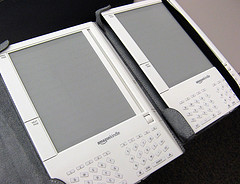
recently, I found myself asking why ebooks haven’t really taken off as a medium. Certainly more recent efforts, such as Amazon’s Kindle, have helped to reignite the market after a rather dubious development period over the past decade or so, but if one compares the ubiquity of mobile phones or digital audio players, e-books are entirely missing from the landscape. ((According to The Guardian
in April 2008, ebooks accounted for less than 1% of the total publishing market, albeit this share has no doubt increased since.))
In purely utilitarian terms, should the technology ever be fully and appropriately used, ebooks have a lot to offer over their paper counterparts. There are far fewer requirements and resources needed for production, and distribution is much easier. Whilst a device on which to read ebooks might outweigh a single volume, additional books add nothing, and in terms of transporting books en mass, ebooks are clearly in favour. The ability to flick through a paper volume might be lost in the electronic form, but this is clearly compensated for by vastly improved tools for search and cross-referencing. Likewise combining other forms of media such as video and audio is a perfectly reasonable conception with ebooks, that the paper variety can’t really compete with on any level. They’re also more easily manipulable, in terms of being able to zoom, highlight or simple leave your own annotations about the place. All of which is to say nothing of the potential advantages for newspapers and other periodicals.
Interesting little snippet
about the current state of South African Internet services. Designed simply to show up the state of South Africa’s Internet options, the test pitted a pigeon against a connection delivered by their largest provider. The pigeon managed to deliver 4GB of data 60 miles in little over an hour, and it took the company another hour to upload the data (one can only assume they were for some reason using an old USB 1.o/1.1 connection). In this time, just 4% of the data had been transferred via ADSL. Humbling though this message might be, I really wonder if services in the UK would fare much better? At a rough estimate, in the total amount of time it took the pigeon, my own connection might have managed around 5% of the total. The average business connection would probably have achieved twice that, but either way, the pigeon method wins hands down. Having said that, I don’t think we’ll be seeing any alternative pigeon networks set up in the UK just yet. ‘Packet loss’ due to hawk attacks would be monumental.
Many of us have found ourselves in this position. Your business or group make use of an online system, such as a forum, wiki, blog etc., which you then wish to augment or combine with some other system. How you go about doing that, of course, depends entirely on your goals and the systems you’re trying to use together. Design and styling are usually the least of those worries.
The problem which consistently presents itself when attempting such a combination is what to do with the userbase. Whilst this issue can sometimes be simply ignored, in the hope that only a small number of the users of one system will need access to the second, this isn’t always the case. When it comes to one userbase requiring access to two or more systems, the first question that needs to be answered is whether the user information should be shared, enabling a unified login procedure amongst other benefits. Requiring users to sign up to various different pieces of the puzzle is a time-consuming process, and one that many will find confusing and unnecessary. And since different online systems often have conflicting requirements when it comes to usernames and passwords, for example, this can also lead to more lost password checks and work for the system administrator. However, programming such functionality oneself certainly isn’t within the realms of the abilities of all of us, and keeping such modifications functioning across various systems and versions can be a painful procedure.
It’s all a bit late now. Boris Johnson
writes about the Gary McKinnon case in The Telegraph
and points out what anyone living under a rock wearing a bag on their heads could already see. McKinnon is charged with breaking into US military computers from his 56k modem, leaving messages, deleting files and causing general mayhem. He admits to all accounts of hacking in, though denies deliberate attempts at causing damage, claiming these charges were invented to pursue extradition proceedings. Quite what the prosecutors are trying to achieve with this man are unclear, given that his crazy quest for the secrets of little green men and free energy actually provided a service to the US military authorities in pointing out their lax security. As Boris Johnson points out, they could as well be offering him consultancy fees, as trying to clap him in irons. But how long does it take before someone is willing to stand up for common sense? And given the seemingly endless machinations of the legal process, will such calls even have an affect? Aside from highlighting the blatant partiality of the US-UK Extradition Treaty, these proceedings have once more underlined the spinelessness of the UK government when it comes to rectifying gross injustice, and defending its people against what can only be described as foreign tyranny. Watching paint dry, grass grow, the wheels turn in Whitehall: the simile edges ever closer to a regular place in our vocabularies.
In a multi-record breaking event, marred by controversy over the technology of the new swimsuits
, the final day of the 2009 World Aquatics Championships featured a fairly typical line-up for the Men’s 4 x 100m Medley Relay
. Aside from Australia replacing Canada, and Brazil in place of Italy, the event could very well have been made for the G8. A fact no less marked than that the victors had a full replacement team to the one that qualified earlier in the day. Whoever said sport and money were a bad combination?
President Truman famously kept a sign on his desk that said “The buck stops here”, a gift from an avid poker player. Yet whilst we might appreciate the imagery and the sentiment, should we really rely on there being a ‘buck
’ to pass? Is there always a man in charge, someone with whom the ultimate responsibility lies? The public at large like to believe so. Having someone who is nominally in charge provides a feeling that there is some level of control over daily events, that there is some direction to the madness that seems to govern our lives. It isn’t particularly important whether that person you believe in is God, the president, the Führer or Chuck Norris. Nor does that responsible person need to be an individual, it can just as easily be taken as being particular position, a group of people, or an organisation.
Yet having someone to look to as the ‘Man in Charge’ also entails having someone to blame when things go wrong. In general, people are not willing to look at events as the result of complex systems of uncountable interconnected threads. Such systems lack palpability, they invoke confusion and lack obvious conclusions. Much easier to view events as the result of simple inputs and outputs, revolving around the decision-making roles of important personages. When the proverbial hits the fan, the easiest response is to find those at the helm, whether particular individuals or a group, and lay the blame as thick and fast as the cement mixers can provide it. It’s a simple and effective reaction, since any person that can be held culpable must have made decisions, and any decision can be deemed retrospectively fallacious. Ergo any individual can be made and held responsible. ((We should not forget, of course, that as much as we enjoy seeing certain individuals as being responsible for the workings of the world, both for the comfort it gives us whilst things are ticking along smoothly, as well as the convenience of having someone to blame when they don’t, the individuals themselves also enjoy a level of revelry in the illusion that they are the ones with all the answers.))