All Tourists are Potential Terrorists
Left 4 Dead Review
For whatever reason, Valve deemed last weekend to be worthy of celebration, and in addition to offering a welcome discount, offered a free trial for their action-packed zombie fest Left 4 Dead . Never one to pass up on such offers, and having a few friends who’d already bought the game, I spent a fair few hours last weekend testing the game out, enough so to have convinced me to actually buy the thing!
Whilst Left 4 Dead sits firmly in the survival horror genre, it is without a doubt a shooter through and through. Whilst the genre may have its early origins with games like Alone in the Dark , Left 4 Dead is to that what 28 Days Later is to Night of the Living Dead . It’s a high-energy bloodbath, which is well and truly the game’s essence. Forget setting, plot or character development, the game boils down to an assault course for four, through levels strewn with zombies to some method of escape, with occasional safe points along the way.
That might not sound particularly novel, but the game’s central tenet is its co-operative side. Whilst there are plenty of games past that have featured zombies in one way or another, none have quite provided the experiences associated with the stereotypical zombie genre. Left 4 Dead clearly owes a lot to the zombie movie, from the opening intro to the closing credit sequences, and the gaming world has been truly aching for such a game. Mods such as Zombie Panic! or Zombie Master filled a gap, but Left 4 Dead has made full use of the Source engine to create a movie experience built for four.
The Repeatables
This isn’t meant to be a list of classic films. In fact, many classics would find it difficult to creep on to this list. These films don’t have to have bemusing screenplays, flawless acting, blood-pumping soundtracks, or brilliant cinematography. But they are all linked by that special je ne sais quoi which makes me able to watch them time and time again. That isn’t to say there aren’t plenty of great movies that share this rather dubious accolade. I could and would watch many of them again, but the experience is always be somewhat diminished from that initial viewing.
The films on this list, however, have something special that gives them enduring longevity. It’s not the film itself but the film experience that counts. With the intricacies of the plot laid bare, the twists, turns, shocks and surprises all blunted by experience, what’s left is whatever ethos the film can conjure up. Which is precisely what some cult classics manage so successfully. Umberto Eco once wrote that “Casablanca became a cult movie because it is not one movie. It is “movies”.” ((Umberto Eco, Travels in Hyperreality, (London, 1986), p. 208.)) His point was that the film itself wasn’t any particular gem, but it encapsulated what movie-goers expected to see. The lines were famous before they were spoken, perhaps the most famous line of all being the one that wasn’t even in it (“Play it again, Sam”). But films that are able to do that go on to be remembered long after they’re made, irrespective of their individual merits and the quality of their cinematography, acting or screenplay.
This is simply a list of films that qualify merely on account of springing to mind first when considering what makes a film rewatchable. They’re mostly quite mainstream, with a heavy slant on the action side, no doubt in part because drama is a singularly poor trait for repeat value. But they are foremost a very personal example, and I doubt whether others will share even a portion of their number.
Reliving an Old Gaming Experience
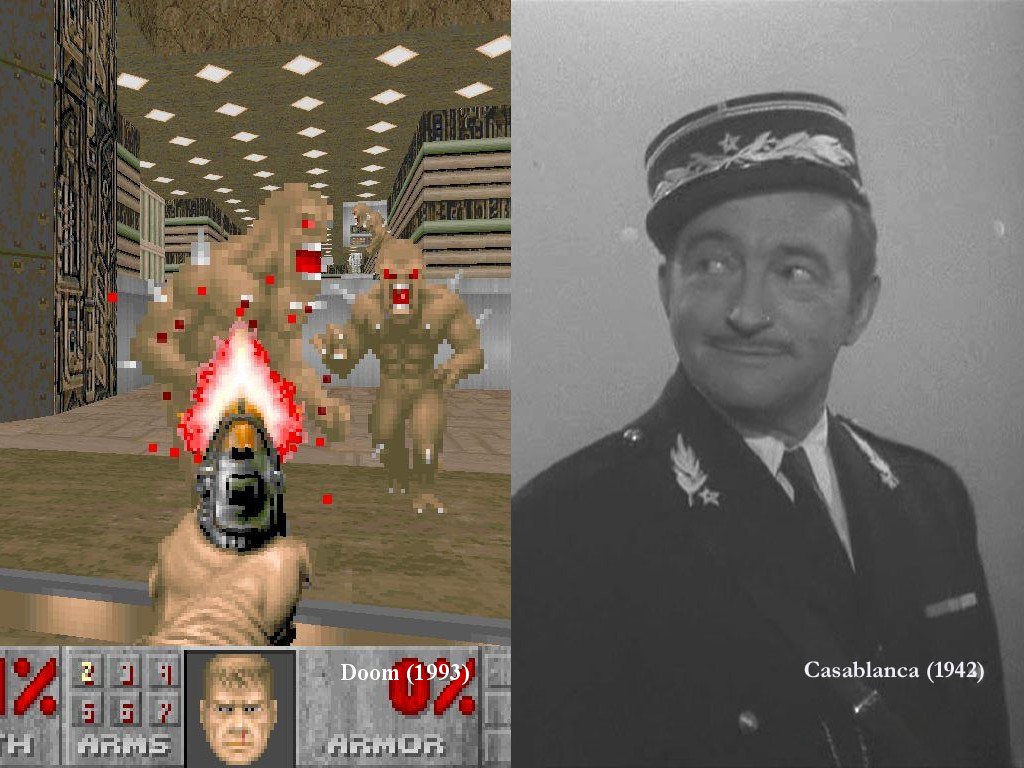
Casablanca and Doom
In comparison to a medium like cinema, computer games suffer from a particularly poor level of longevity. The vast majority of films can still happily be viewed today, often in an updated format, though keeping to the original production. That isn’t to suggest that films do not become dated, nor that more than just distribution formats are updated in later productions. Only recently I had the privilege of watching a once lost silent Polish film, A Strong Man (Mocny Człowiek ), rediscovered in 1997. As there were no hints as to what musical accompaniment was meant to be played with the film, the DVD was released with a modern ambient style, that took a short while to get used to, but actually fit the film’s plot and style rather beautifully. On the whole, however, a film produced fifty years ago can be viewed with much the same clarity today as on the day it was released.
Worms under DOSBox
Longitude

Longitude
Playing with the WordPress Database
After initially solving my database character encoding problems by ignoring the specific strings in the wp-config.php file, I was finally forced to alter the characters in the database during a recent reshuffle. Whilst there are two automated solutions available via plugin, namely g30rg3x ’s UTF-8 Database Converter and the Modified UTF8 Sanitize Plugin , sadly neither worked in my particular instance, and indeed the former is no longer supported for current versions of WordPress, though reports on the WordPress support forum suggest there should be no issues.
Fortunately, an excellent guide was available on Alex King’s blog . For more information and follow-up comments, you should definitely read the full post, but here’s a summary of the method that worked for me.
The Infected German Language
Phantoms in the Brain
In Phantoms in the Brain, V. S. Ramachandran has attempted to emulate the forebears he cites in the Preface, who inspired him to write science that is both informative and interesting to the general reading public. In this he has certainly succeeded, his style is highly approachable, and the content not only comprises interesting titbits, but wholly thought-provoking suggestions and analyses. I picked up Phantoms in the Brain on the basis of a recommendation from a friend more involved in the scientific fold than I am, yet found the book to be readily accessible to these with even only a meagre understanding of the way our brains function.
The book is for the most part concerned with the fundamental inner workings of the brain revealed to us through curiously specific medical conditions, often brought about by severe physical traumas such as strokes. Some of the findings are, perhaps, fairly well known by now, yet I’ve no doubt that many will still be quite shocking to most readers. However, Ramachandran keeps the presentation of both old and new findings fresh, in his natural inquisitive approach to each individual problem. His curiosity and novel attitude in dealing with many of these strange rarities of medical science at times remind one of the naïve questioning of a young child, who by approaching problems from altogether unexpected angles can come up with profound thoughts and solutions that would not normally strike an adult.