Searching the Internet for a comparison of CRT and LCD monitors will soon find numerous assertions that the lifespan of an LCD monitor exceeds that of a CRT. Just take one such example from Matrox Graphics’ website
:
Longer monitor lifespan: Generally, LCD monitors last longer than CRTs. A typical LCD lifespan is 50,000 hours of use compared to 15,000 to 25,000 for a CRT. A longer monitor lifespan can provide a better return on investment.
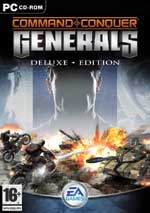
Obviously C&C Generals and her Zero Hour expansion pack are neither new nor even current titles, so this review comes rather late in the day. Nevertheless, with the next generation of titles in the pipeline from EA (in the guise of C&C3) and Chris Taylor’s Supreme Commander (spiritual successor to Total Annihilation), it might be worth highlighting a few of the problems with this older incarnation of the RTS genre. Whilst the genre was built on the single-player campaigns of the original C&C and co., it lends itself beautifully to the world of multiplayer, and this is where the focus of this little review lies. First of all, it is only fair to point out that EA have managed to create an untypically balanced game out of the three very varied factions. When one counters in the major differences attributable to the ‘Generals’ of the game’s expansion pack, it is surprising that, at least to a mediocre standard of play, the game offers twelve competitive teams and therefore plenty of diversity in tactics, as teams try to exploit one another’s weaknesses. Of course, this is not to say that certain combinations of opponents do not bias the outcome of the game, and at the top level of the game it should not normally be possible, for example, that a China Infantry team will beat a GLA Toxin enemy. Yet simply by looking at the daily win percentages produced on the game’s online service, one can see that although one or two teams generally have a slight advantage statistically, in general the spread between the twelve factions in terms of victories is very close.
It should be pointed out that these observations take into account only a low-to-medium standard of play. Naturally at the top end of the game, the rules change almost beyond comparison. But the basic point is that C&C Generals still has regular players of all standards, and as a result, gamers can expect a wide variety of different tactics being produced on the field. The closer one gets to the top, of course, the more emphasis on the ‘real-time’ strategy elements of the genre, i.e. time management - the rush. Getting troops onto the field, micromanaging them, and using them to the greatest effect is the essence of the game, and new players will often find a number of variants in this line being used against them. But to make comparison with WarCraft 3, where nearly every game for the beginner will end in a high-level undead hero and an army of crypt fiends storming into their base, whilst they are yet fighting some local creeps, new C&C Generals/Zero Hour players can expect to at least put up a fight, even where this may sometimes feel to be completely ineffectual.
Apparently, getting what you paid for isn’t necessarily the name of the game any more. Although I was well aware of it at the time of purchase, no niggly smallprint or obligatory T&C which no one reads hid this caveat, it still comes as something of a surprise to be informed that something I paid for disappeared if I don’t use it. In my personal experience, Skype hasn’t done itself many favours in terms of maintaining a decent service. Certainly, it ‘does what it says on the tin’ the majority of the time, indeed it was only as I decided to test Skype’s SkypeOut feature (which worked handsomely, to the company’s credit) that I came across this email. This quote, in particular, amused:
This new weapon developed jointly by the Israelis and Americans purports to be a revolutionary new idea, but firearms afficianados will no doubt remember the “Krummer Lauf” modification to the German Sturmgewehr 44of some sixty years previous. With seemingly questionable construction, the weapon would suit only the most specialised of tasks, and without decent training and experienced handling could easily result in costly errors, which the weapon is designed to avoid.
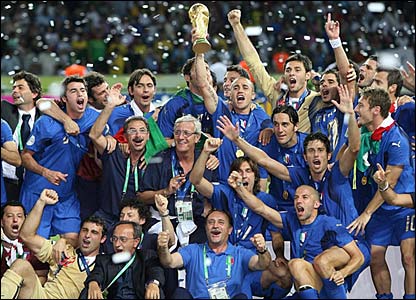
So Italy have taken the title for a fourth time, bringing their tally to four, edging them out as the best in Europe, and ending what should be acknowledged as one of the worst tournaments in recent memory. For the second time in its history, the final was settled on a penalty shoot-out, the feeling of the fans towards the end soured by a red card for Zinedine Zidane for headbutting Marco Materazzi.
There can be little doubt that the tournament was marred by some dire games, poor refereeing decisions, strange FIFA interference, and a generally lack-lustre performance from many of the teams, particularly towards the end of the tournament. Can any blame be apportioned for this? Or was it simply the luck of the draw that this tournament was destined to be poor viewing for the spectators? Of course, credit should be apportioned where it is due, and both the hosts and the fans did an excellent job in ensuring the tournament was shrouded in a carnival atmosphere, and the focus for the media could be left to the football.
As is perhaps to be expected in this day and age, everywhere you look at the moment there’s football, football, football. The World Cup is more than just a spectacle, it’s a regular event and therefore presents an opportunity. An advert which doesn’t in some way link the Beautiful Game to washing powder, mortgages or anti-wrinkle cream is almost refreshing. Of course, the World Cup would not be so all-pervasive without the weight of corporate advertising and media on the bandwagon, but there are some underlying psychological effects, which are being harnessed as only corporate business knows how.
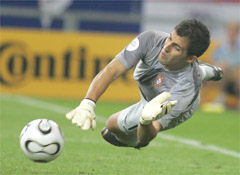
Just think how many millions view the games, particurlarly of the home nation; viewing figures suggest around 19 million households tuned in to watch the England v Portugal match, and that number masks the people watching with friends, at home or in public. Of course, cutting away the naturally avid football fans leaves a significant number simply watching to support their national side, but how does this turn into something of a fever? The rampant nationalism provoked at times staggers belief, and often goes far beyond the football itself. Finding sensible criticism
of England’s performance at the World Cup is some achievement, whilst in the immediate aftermath of England’s exit, jingoistic slurs against Portuguese players and Argentine referees were on the tip of many tongues.
The recent furor over Avian Flu has no doubt led many of us to believe that a dangerous worldwide pandemic looms on the horizon. There is little doubt in the scientific community that should the H5N1 strain of the virus mutate into a form easily communicable between humans, the virus will show much greater potency than current pathogenic influenza viruses, owing to the lack of immunity within the population of this new ‘avian’ form.
Yet just what can governments and scientific bodies do to allay fears and combat the disease? In the latter regard, there is precious little which can be done beyond monitoring the condition in the bird populations. So why then is the disease so readily in the popular news? Are we seeing the same variety of overhyped scare-mongering that accompanied the BSE/vCJD crisis of the previous decade? In 2000, the BBC used the headline CJD deaths ‘quadrupled since 1995’to illustrate a meagre rise in the real term numbers of cases (unfortunately the page can no longer be found on the BBC website, the link uses Google’s cache). Of course, given the way that particular disease manifested itself there was every chance that should an epidemic result, the clock would already be ticking for a vast section of the population.